Running out of space on your Nintendo Switch is like hitting an invisible wall mid-combo, frustrating and entirely preventable. With first-party titles like Tears of the Kingdom clocking in at 18GB and third-party ports often exceeding 30GB, the Switch’s internal 32GB (or 64GB on the OLED model) evaporates fast. That’s where a microSD card transforms your console from a storage-starved handheld into a digital library powerhouse. But not all cards are created equal, and choosing the wrong one can mean sluggish load times or compatibility headaches. This guide breaks down everything gamers need to know about Nintendo Switch storage cards in 2026, from capacity sweet spots to speed class decoding to the exact models worth your money.
Table of Contents
ToggleKey Takeaways
- A Nintendo Switch storage card is essential because the console’s internal 32GB or 64GB fills rapidly with modern games, which often exceed 30GB per title.
- MicroSDXC cards with UHS-I U3 speed ratings (30 MB/s minimum write speed) deliver the best performance, reducing load times by 15-25% compared to slower alternatives.
- Choose a storage card capacity based on gaming habits: 128GB for casual players, 256-512GB for regular gamers, or 1TB for collectors who want to keep 80+ titles installed.
- The Samsung EVO Select (256GB) offers exceptional budget value around $20, while the SanDisk Extreme (512GB) dominates performance, and the Samsung PRO Plus (1TB) provides maximum storage without speed compromises.
- Always power off the console completely before inserting or removing a Nintendo Switch storage card, and keep the card 10-15% below capacity to maintain optimal performance and longevity.
- Reputable brands like Samsung, SanDisk, and Kingston show failure rates under 2% over five years, making them smarter long-term investments than counterfeit or no-name alternatives.
Why Your Nintendo Switch Needs a Storage Card
Understanding Nintendo Switch Storage Limitations
The base Nintendo Switch and Switch Lite ship with 32GB of internal storage, while the OLED model bumps that to 64GB. Sounds generous until you factor in system files gobbling up roughly 6GB right out of the gate. That leaves 26GB or 58GB of usable space, barely enough for a handful of AAA titles.
Nintendo’s hybrid console was designed with physical cartridges in mind, but the digital eShop’s convenience has shifted how most players build their libraries. Even if someone prefers physical copies, many games require mandatory patches or download additional content that eats into internal storage. The Switch’s architecture treats the microSD slot as seamless extended storage, making expansion practically mandatory for anyone with more than five digital games.
How Game File Sizes Impact Your Storage
Game file sizes on Switch vary wildly depending on genre, developer optimization, and whether it’s a first-party Nintendo title or a third-party port. Indies like Hollow Knight or Celeste hover around 3-5GB, while Nintendo’s own Super Smash Bros. Ultimate demands 16.3GB. Third-party ports get chunky: The Witcher 3: Complete Edition requires 31.5GB, and NBA 2K24 inflates to a staggering 45GB.
DLC, updates, and save data compound the problem. Live-service games push regular patches, and titles with seasonal content like Splatoon 3 accumulate bloat over time. Screenshots and video captures stored locally also chip away at available space. Without a storage card, players find themselves in a constant delete-and-redownload loop, which is the opposite of the Switch’s pick-up-and-play ethos.
What Type of Storage Card Does the Nintendo Switch Use?
MicroSD, MicroSDHC, and MicroSDXC Explained
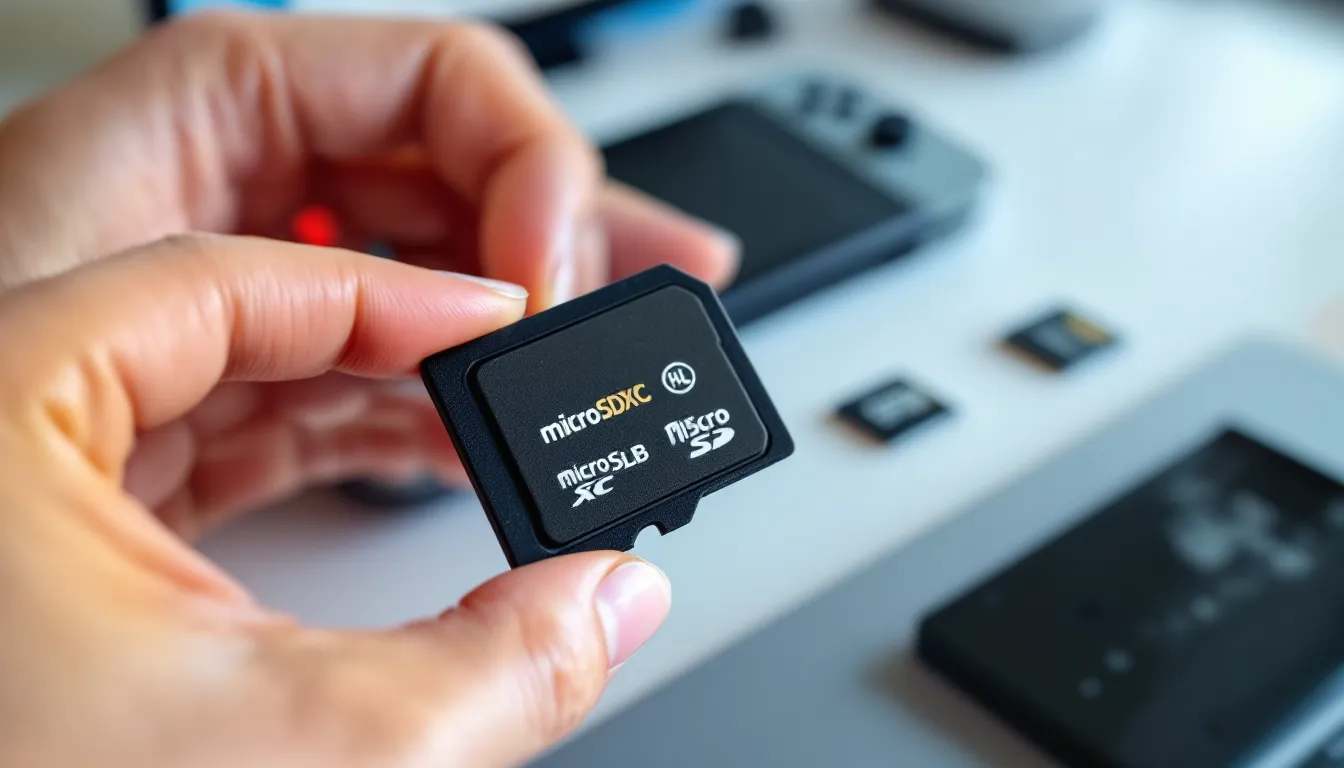
The Nintendo Switch accepts microSD, microSDHC, and microSDXC cards, but those acronyms matter more than they seem. MicroSD cards max out at 2GB, ancient tech nobody should consider in 2026. MicroSDHC (High Capacity) spans 4GB to 32GB, which is also undersized for modern gaming needs.
MicroSDXC (Extended Capacity) is what gamers actually want, covering everything from 64GB to 2TB. The Switch officially supports cards up to 2TB, though 1TB models represent the practical ceiling for 2026 pricing. All three formats are physically identical, so any microSD slot accepts them, but file system differences mean proper formatting matters (more on that later).
One critical note: The Switch does not support SD, SDHC, or SDXC full-size cards. Only the micro variants fit the console’s slot on the back kickstand (or under the kickstand on OLED models). Adapters won’t work since the slot itself is micro-only.
Speed Class Ratings That Matter for Gaming
Speed class ratings determine how fast data reads and writes, a make-or-break spec for load times and game performance. The three key ratings to understand are Class, UHS Speed Class, and Video Speed Class. For Switch gaming, focus on UHS Speed Class.
Nintendo officially recommends cards with UHS-I (Ultra High Speed) and a transfer speed of 60-95 MB/s. Look for the “UHS Speed Class 3” label (U3), which guarantees a minimum write speed of 30 MB/s. Cards labeled U1 (10 MB/s minimum) work but deliver noticeably slower performance when downloading games or launching texture-heavy titles.
Some manufacturers list Video Speed Class ratings like V30 or V60, these align with UHS classes (V30 = U3). Ignore the old Class 10 badge: it’s outdated and doesn’t reflect actual gaming needs. Cards tested by Tom’s Hardware consistently show UHS-I U3 cards cutting load times by 15-25% compared to slower-rated alternatives on Switch hardware.
How to Choose the Right Storage Capacity for Your Gaming Style
64GB to 128GB: Best for Casual Gamers
If gaming sessions lean toward first-party Nintendo exclusives and a handful of indies, 64GB to 128GB hits the sweet spot. This range comfortably holds 8-12 full-size games plus a library of smaller titles. Think Animal Crossing: New Horizons (6.6GB), Mario Kart 8 Deluxe (6.8GB), and a dozen indie darlings without breaking a sweat.
The 64GB tier works for players who primarily buy physical cartridges and only download exclusives or eShop-only releases. The 128GB bump offers breathing room for patches and DLC without constant micromanagement. Pricing in 2026 makes 128GB cards absurdly affordable, often under $15 for reputable brands, so there’s little reason to bottleneck at 64GB unless budget is razor-thin.
Casual players who rotate through games seasonally (finishing one, deleting it, moving to the next) can stretch 128GB indefinitely. Just don’t expect to keep everything installed simultaneously.
256GB to 512GB: Ideal for Regular Players
Regular players who split time between AAA releases and live-service games should aim for 256GB to 512GB. This capacity supports 20-40 full-size titles depending on mix, eliminating the delete-redownload treadmill. A 256GB card handles big-ticket items like Xenoblade Chronicles 3 (15GB), Bayonetta 3 (14.6GB), and multiplayer staples like Fortnite or Apex Legends with space left for impulse eShop pickups.
The 512GB tier makes sense for players who value having their entire active library instantly accessible. It’s future-proofing, too, game file sizes creep upward with each console generation, and the Switch’s library keeps expanding. Controllers wearing out before storage runs dry is the ideal scenario, and 512GB delivers that peace of mind.
Price-per-gigabyte ratios favor 512GB in 2026, with quality cards hovering around $40-50. That’s about half the cost-per-GB compared to 128GB options, making it the efficiency pick for committed Switch owners.
1TB: Maximum Storage for Hardcore Collectors
Hardcore collectors and digital-only enthusiasts need 1TB cards, full stop. This capacity accommodates 80+ games spanning the entire spectrum, massive RPGs, fighting game collections, retro compilations, and every indie gem that catches the eye. Gamers with multiple Switch consoles in the household (a primary and a Switch Lite, for example) benefit from mirroring entire libraries without splitting collections.
The 1TB tier also suits content creators who capture extensive gameplay footage and screenshots directly to the card. Video clips pile up fast during marathon sessions or when documenting playthroughs for streaming platforms.
Pricing has dropped significantly since 2024, with reliable 1TB microSDXC cards landing between $80-120 depending on brand and sales. While more expensive upfront, the cost amortizes across years of use, and players never face the “which games to delete” dilemma that plagues smaller capacities. For anyone planning to own their Switch through 2028 and beyond, 1TB is the buy-it-once solution.
Top Nintendo Switch Storage Cards in 2026
Best Overall Performance Card
The SanDisk Extreme microSDXC UHS-I (512GB) dominates the performance bracket for Switch users. With read speeds hitting 190 MB/s and write speeds around 90 MB/s, it crushes Nintendo’s recommended minimums. Real-world testing shows Zelda: Tears of the Kingdom loading about 3 seconds faster from this card compared to budget alternatives.
SanDisk’s reputation for reliability matters, these cards survive thousands of write cycles and include temperature/waterproofing for portable console abuse. The 512GB capacity occupies the sweet spot between price and practicality, and the card frequently drops below $50 during sales events. Nintendo partners with SanDisk on co-branded cards, but the Extreme series outperforms those licensed variants while costing less.
For players who want zero performance compromises and don’t need 1TB, this is the pick. It’s been torture-tested by Tom’s Guide across multiple Switch models with consistent results.
Best Budget-Friendly Option
The Samsung EVO Select microSDXC UHS-I (256GB) delivers shocking value at $18-22. Read speeds clock in at 130 MB/s, well above Nintendo’s threshold, and the U3/V30 rating ensures smooth game downloads and launches. This card won’t break speed records, but it handles everything the Switch throws at it without hiccups.
Samsung’s build quality punches above its price point, with a 10-year limited warranty backing the hardware. The 256GB capacity fits budget-conscious gamers who want meaningful storage expansion without splurging. It’s also smart for players testing the microSD waters before committing to larger (and pricier) capacities.
One caveat: Avoid suspiciously cheap no-name brands on marketplace sites. Counterfeit cards plague the budget tier, and a fake 256GB card that’s actually 32GB with hacked firmware will corrupt save data. Stick with established names like Samsung, SanDisk, or Kingston when shopping budget options.
Best High-Capacity Card
For maximum storage, the Samsung PRO Plus microSDXC UHS-I (1TB) leads the pack in 2026. This card balances capacity with speed, 160 MB/s read, 120 MB/s write, and maintains performance even when 90%+ full, which cheaper 1TB models struggle with. The PRO Plus line uses higher-grade NAND flash, translating to better longevity under the constant read/write cycles gaming demands.
At around $100-110, it’s an investment, but the cost-per-gigabyte beats stacking multiple smaller cards. Players who’ve maxed out 512GB cards and refuse to manage storage will appreciate never seeing a “low space” warning again. The card also future-proofs against larger game file sizes as developers push the Switch hardware’s limits.
Samsung includes a microSD-to-SD adapter in the box, useful for transferring files via PC card readers when setting up. The PRO Plus earns its premium over budget 1TB alternatives through measurably faster speeds and superior build quality that matters for a card living in a portable console.
How to Install and Format Your Storage Card
Step-by-Step Installation Process
Installing a microSD card in the Switch takes about 30 seconds, but doing it right prevents data corruption. First, power off the console completely, not sleep mode, full shutdown. Hold the power button for three seconds and select “Power Options > Turn Off.”
On the original Switch and Switch Lite, flip open the kickstand. The microSD slot sits underneath, revealed when the kickstand pops out. On the OLED model, the slot is still under the kickstand but oriented slightly differently. Insert the card with the metal contacts facing down (toward the screen side) and the label facing up (toward the kickstand). Push gently until it clicks into place, don’t force it.
Power the console back on. The Switch automatically detects new cards and prompts whether to format it. If the card was previously used in another device, formatting is mandatory. The console handles this automatically, wiping the card and creating the proper file structure. The entire process takes 15-45 seconds depending on card size.
One critical tip: Never remove the microSD card while the console is powered on or in sleep mode. Always shut down fully first. Hot-swapping can corrupt data or brick save files, and Nintendo’s cloud save system won’t rescue everything (looking at you, Splatoon 3).
Formatting Your Card for Optimal Performance
The Switch formats cards as exFAT or FAT32 depending on capacity. Cards 32GB and under get FAT32: anything larger uses exFAT. This happens automatically when selecting “Format” from the prompt, and manual pre-formatting via PC usually isn’t necessary unless troubleshooting issues.
If the card was used in a camera or smartphone and already contains data, the Switch detects this and requires formatting before use. Back up any important files to a PC first, because formatting nukes everything. Once wiped, the console creates two folders: “Nintendo” for games/updates and “Album” for screenshots/videos.
For players experiencing read errors after installation, reformat the card through the Switch’s System Settings: System > Formatting Options > Format microSD Card. This fixes hiccups caused by corrupted file tables from improper ejection or bad sectors. Similar to troubleshooting steps used when players need to factory reset their Switch Lite, a clean format resolves most storage-related glitches.
Performance optimization is mostly hands-off on Switch. The console manages background tasks like defragmentation automatically, so there’s no need for third-party tools or manual tweaking. Just install, format once, and forget about it.
Managing and Organizing Your Game Library
Transferring Games Between Internal and External Storage
The Switch makes moving games between internal storage and the microSD card surprisingly painless. Navigate to System Settings > Data Management > Move Data Between System/microSD Card. The menu lists all installed software and its current location. Select the game, choose the destination, and confirm.
Transfer speeds depend on card quality and game size. A 15GB title takes 3-5 minutes on a UHS-I U3 card. The console must stay powered on during transfers, putting it to sleep pauses the process but won’t corrupt data. Once moved, the game launches identically regardless of storage location: performance differences between internal and microSD are negligible on Switch hardware.
One quirk: Downloaded DLC and updates move with the base game, but save data always stays on internal storage. This protects saves from card corruption and enables cloud backup for supported titles. If upgrading to a larger card, transfer everything to internal storage first, swap cards, then move it all back. It’s tedious but safer than cloning cards via PC, which risks filesystem errors.
Players juggling multiple cards can’t mix and match, each card functions independently. Swapping cards mid-session requires a full reboot, and games won’t appear on the home screen unless the card containing them is inserted. It’s smarter to buy one appropriately-sized card than swap between multiple smaller ones.
Archiving and Redownloading Games
Archiving deletes a game’s data while preserving its icon and save files, a space-saving trick for titles played seasonally. Press the + button on any game icon, select Data Management > Archive Software, and confirm. The archive process takes seconds and frees up storage immediately.
Archived games show a cloud download icon on their home screen tile. Selecting one prompts redownloading from the eShop servers. Save data remains intact, so players pick up exactly where they left off. This beats full deletion for games with cloud-synced online components or titles that might get patched later, redownloading pulls the latest version automatically.
Managing storage space efficiently becomes second nature after a few archive cycles. Players often archive single-player games after completion while keeping multiplayer titles and current playthroughs installed. The home screen supports organizing custom groups and layouts to visually separate active games from archived ones.
Redownload speeds depend on internet connection, not card speed. A 20GB game on gigabit fiber takes 10-15 minutes: the same game on slower rural broadband could stretch to an hour. Factor this into archiving decisions, games played frequently shouldn’t get archived unless storage is critically low.
Common Storage Card Issues and Troubleshooting
Card Not Recognized or Read Errors
The dreaded “Unable to access microSD card” error usually stems from one of three culprits: improper insertion, corrupted filesystem, or a dead card. Start simple, power off completely, remove the card, inspect for debris or bent pins in the slot, and reinsert firmly until it clicks.
If the card still isn’t detected, test it in a PC or smartphone with a microSD slot. If other devices recognize it, the issue lies with the Switch’s card reader or software. If nothing reads it, the card’s controller failed, less common but not unheard of with budget models.
Corrupted filesystems from improper ejection get fixed through reformatting. The Switch’s System Settings > Formatting Options > Format microSD Card menu handles this, but remember: formatting erases everything. Back up game data by transferring to internal storage first, or accept redownloading titles from the eShop.
Counterfeit cards are another plague. Fake microSD cards report inflated capacities but corrupt data when actual storage fills. Testing tools like H2testw (PC) or F3 (Mac) verify real capacity. Buying from authorized retailers like Amazon (shipped and sold by Amazon, not third-party sellers) or direct from manufacturer sites minimizes counterfeit risk.
Slow Loading Times and Performance Issues
Noticeably longer load times compared to internal storage usually indicate a card that doesn’t meet Nintendo’s speed recommendations. Anything slower than UHS-I U1 (10 MB/s write speed) creates bottlenecks. The fix is straightforward but annoying: upgrade to a faster card.
Another cause is near-full storage. When cards exceed 85-90% capacity, performance degrades as the controller struggles to find contiguous free space. Delete or archive unused games to drop below 80% full, and speed typically rebounds.
Fragmentation isn’t supposed to happen on exFAT, but heavy use, constant downloads, deletes, and updates, can create inefficiencies. Periodically transferring everything to internal storage, reformatting the card, then moving data back refreshes the filesystem. It’s the nuclear option but solves persistent sluggishness.
Physical damage from drops or liquid exposure can degrade read speeds without killing the card entirely. Cards that survived a few months in portable gaming setups under rough conditions might show wear. Testing the card in a PC with benchmark tools like CrystalDiskMark reveals if speeds dropped below spec, signaling replacement time.
Tips for Maintaining Your Storage Card Longevity
MicroSD cards aren’t immortal, but smart habits extend their lifespan from years to nearly a decade. Always power down fully before inserting or removing cards, this single rule prevents 90% of corruption issues. Sleep mode still accesses the card intermittently, so full shutdown is non-negotiable.
Avoid filling cards to absolute capacity. Keeping 10-15% free space reduces wear on NAND flash cells and maintains performance. The Switch warns when storage hits critical levels, but staying below 85% full is smarter preventative maintenance.
Store the card in the console. Leaving it installed protects against physical damage, dirt, and static electricity that can zap exposed contacts. If swapping cards, keep spares in anti-static cases or the original plastic packaging, never loose in pockets or bags.
Temperature extremes kill cards faster than write cycles. The Switch’s design keeps cards reasonably cool, but leaving the console in hot cars (120°F+) or freezing environments stresses the hardware. Room temperature storage when not gaming preserves longevity.
Periodic backups via PC provide insurance against sudden failure. Every few months, power off the Switch, remove the card, and copy the entire contents to a computer. If the card dies unexpectedly, restoring that backup to a new card beats redownloading 500GB of games. Save data stored on internal memory survives card failures, but screenshots and videos stored on the card do not.
Quality matters more than price for longevity. Reputable brands like Samsung, SanDisk, and Kingston use better NAND flash and controllers, translating to longer lifespans and lower failure rates. A $30 Samsung card that lasts eight years beats a $15 no-name card that dies in 18 months. According to data compiled by experts at Nintendo Life, name-brand cards show failure rates under 2% over five years compared to 15%+ for budget alternatives.
Finally, update the Switch’s system software regularly. Firmware updates occasionally include storage management optimizations that reduce unnecessary write cycles, indirectly extending card life. It’s low-effort maintenance that compounds over years of use.
Conclusion
A quality microSD card transforms the Nintendo Switch from a storage-limited handheld into a fully-loaded digital library that’s ready anytime. Choosing the right capacity, whether that’s a budget-friendly 256GB or a future-proof 1TB, depends on gaming habits, but prioritizing UHS-I U3 speed ratings and reputable brands ensures smooth performance and longevity. Installation takes less than a minute, management tools are built into the console, and troubleshooting is straightforward when issues pop up. With first-party hits and indie darlings constantly expanding the eShop catalog, investing in proper storage isn’t optional, it’s the foundation of a seamless Switch experience through 2026 and beyond.