The Nintendo Switch didn’t just launch, it redefined what a gaming console could be. After the Wii U’s lukewarm reception, Nintendo needed a win, and on March 3, 2017, they delivered one that would reshape the industry. But the Switch story isn’t just about a single release date. It’s a timeline of strategic reveals, multiple hardware iterations, and a sustained dominance that’s still going strong in 2026. Whether you picked up the original at launch, grabbed a Switch Lite for portable play, or recently upgraded to the OLED model, understanding when and how each version hit the market gives context to one of gaming’s biggest success stories. This complete timeline breaks down every major release, the hype that built before launch, and what made the Switch’s arrival so significant for gamers everywhere.
Table of Contents
ToggleKey Takeaways
- The Nintendo Switch launched on March 3, 2017, as a global hybrid console that allowed players to seamlessly transition between TV docked play and handheld gaming, fundamentally reshaping the industry.
- The original Switch launch was supported by killer app The Legend of Zelda: Breath of the Wild, which achieved nearly 100% attach rates and justified the $299.99 price tag from day one.
- Nintendo released two hardware iterations of the Switch: the Switch Lite (September 2019) at $199.99 for handheld-only players, and the Switch OLED Model (October 2021) at $349.99 with a superior 7-inch OLED screen and enhanced features.
- The Nintendo Switch became a massive success story, surpassing 145 million units sold by 2026 and ranking among the best-selling consoles ever, trailing only the PlayStation 2 and Nintendo DS.
- The hybrid design revolutionized the gaming industry by proving players valued flexibility and portability as much as raw power, causing competitors to rethink their strategies and Indies to thrive with over 3,000 titles on the platform.
The Original Nintendo Switch Launch: March 3, 2017
What Made the Launch Date Significant
Nintendo chose March 3, 2017 for the Switch’s global launch, a Friday, strategically timed for a weekend full of uninterrupted gaming. The date landed outside the traditional holiday release window, a bold move that showed Nintendo’s confidence in the hardware. By avoiding the crowded November-December period, the Switch had breathing room to dominate headlines and store shelves without competing against AAA blockbusters from other publishers.
The timing also positioned the console perfectly for the spring and summer months, building momentum toward the holiday 2017 season. Nintendo had learned from the Wii U’s mistakes: launch strong, launch global, and give people a reason to buy immediately. That reason came in the form of one killer app that justified the $299.99 price tag from day one.
Launch Titles and Day-One Lineup
The Legend of Zelda: Breath of the Wild carried the Switch launch almost single-handedly, and it worked. The game released simultaneously on Wii U, but the Switch version became the definitive experience, portable Hyrule was a game-changer. Early adopters reported attach rates near 100%, meaning almost everyone who bought a Switch walked out with Zelda.
Beyond Breath of the Wild, the day-one lineup included:
- 1-2-Switch – A tech demo disguised as a party game, showing off the Joy-Con’s capabilities
- Super Bomberman R – Konami’s franchise revival, offering local multiplayer
- Snipperclips – A charming indie puzzle game perfect for co-op
- Just Dance 2017, Skylanders Imaginators, and a handful of third-party ports
The launch library wasn’t massive, but it didn’t need to be. Zelda alone gave hardcore gamers hundreds of hours of content, while families had accessible options. Within the first month, additional titles like Shovel Knight: Treasure Trove and FAST RMX filled gaps in the eShop.
Global Release Regions and Pricing
The Switch launched simultaneously across major markets on March 3, 2017, a coordinated global rollout that included North America, Europe, Japan, and other key regions. This synchronization prevented the frustrating staggered releases that plagued previous Nintendo hardware.
Pricing varied by region:
- United States: $299.99
- Canada: $399.99 CAD
- United Kingdom: £279.99
- Europe: €329.99
- Japan: ¥29,980
- Australia: $469.95 AUD
The base package included the Switch console, Joy-Con grip, HDMI cable, AC adapter, and the dock. Nintendo offered Neon Red/Blue and Gray Joy-Con color options at launch, with the neon variant quickly becoming the more sought-after SKU. Retailers struggled to keep units in stock through spring and summer 2017, with shortages persisting into the holiday season.
The Nintendo Switch Family: Every Model and Release Date
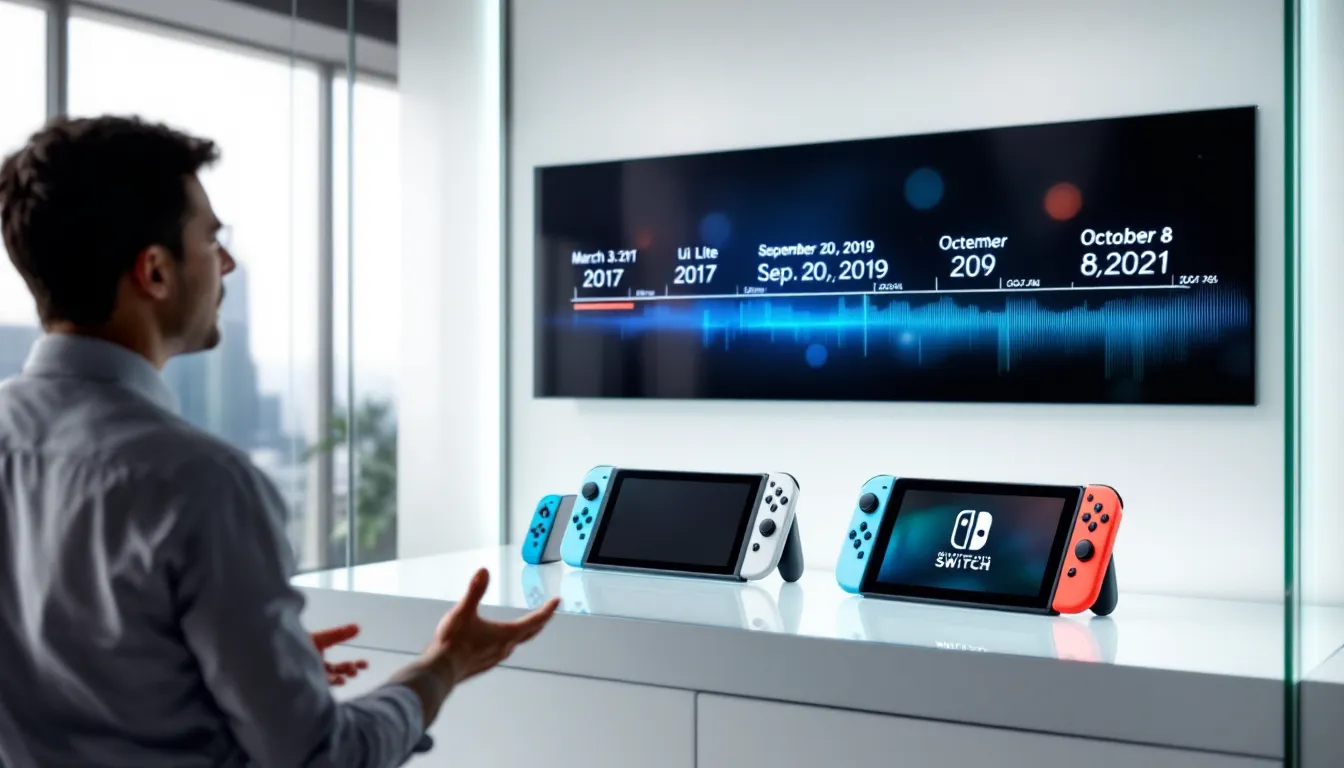
Nintendo Switch Lite (September 20, 2019)
Nintendo expanded the Switch ecosystem on September 20, 2019 with the Switch Lite, a dedicated handheld that ditched the hybrid concept entirely. Priced at $199.99, the Lite targeted younger players, second-console households, and anyone who valued portability over TV play.
Key differences from the original Switch:
- No detachable Joy-Cons – Controls are integrated into the body
- Handheld-only – No TV output or dock compatibility
- Smaller screen – 5.5-inch LCD versus the original’s 6.2-inch display
- Lighter weight – 0.61 lbs compared to 0.88 lbs for the standard model
- True d-pad – A traditional directional pad replaced the separated buttons
The Switch Lite launched in Yellow, Gray, and Turquoise, with special editions like the Pokémon Sword/Shield Zacian and Zamazenta Edition and Animal Crossing: New Horizons Coral Edition arriving later. It’s worth noting that games requiring detached Joy-Cons (like 1-2-Switch or certain Super Mario Party modes) aren’t compatible unless you pair separate wireless controllers. For dedicated handheld players prioritizing games across various age groups, the Lite delivered solid value.
Nintendo Switch OLED Model (October 8, 2021)
The Switch OLED Model arrived on October 8, 2021, offering the first significant hardware refresh for the flagship model. At $349.99, it sat $50 above the standard Switch but delivered meaningful upgrades for both handheld and docked players.
Major improvements included:
- 7-inch OLED screen – Vibrant colors, deeper blacks, and better contrast versus the original LCD
- Enhanced audio – Improved built-in speakers for handheld mode
- Adjustable stand – A wide, sturdy kickstand replacing the flimsy original
- Ethernet port – Built into the redesigned dock for wired online play
- 64GB internal storage – Double the original’s 32GB
The OLED model didn’t upgrade the processor or improve docked resolution, it still maxes at 1080p when connected to a TV. Performance remained identical to the 2019 battery-improved base model, disappointing those hoping for a “Switch Pro” with 4K output. Still, for handheld-focused players, the OLED screen is transformative. Games like Metroid Dread, Splatoon 3, and The Legend of Zelda: Tears of the Kingdom look stunning on the upgraded display.
How the Switch Compared to Previous Nintendo Consoles
From Wii U Disappointment to Switch Success
The Wii U’s failure haunted Nintendo from its 2012 launch through its quiet discontinuation in early 2017. Lifetime sales barely scraped 13.5 million units, a disaster compared to the Wii’s 101 million. Confusing marketing left casual consumers thinking the GamePad was a Wii accessory, not a new console. Third-party support evaporated within a year. Nintendo’s first-party titles, Super Mario 3D World, Splatoon, Mario Kart 8, were excellent but couldn’t save the platform.
The Switch learned from every Wii U mistake:
- Clear identity – The hybrid concept was immediately understandable in trailers and ads
- Unified development – By combining handheld and console teams, Nintendo concentrated resources instead of splitting them between 3DS and Wii U
- Third-party outreach – Nintendo worked aggressively to court indies and AAA publishers, resulting in day-one support from Bethesda, EA, and others
- Marketing execution – The reveal trailer and subsequent presentations nailed the messaging
By the end of 2018, the Switch had already outsold the Wii U’s lifetime total. As of 2026, it’s surpassed 145 million units sold, placing it among the best-selling consoles ever, ahead of the original PlayStation and Game Boy.
The Hybrid Console Innovation
Before the Switch, players chose between home console power and handheld portability. The GameCube, PlayStation 2, and Xbox offered performance and big-screen experiences. The Game Boy Advance, PSP, and 3DS provided gaming on the go. The Switch obliterated that division.
The hybrid design meant:
- Seamless transition – Undock mid-session and continue playing immediately, no save states or cloud sync required
- Tabletop mode – The built-in kickstand enabled local multiplayer anywhere with detached Joy-Cons
- Unified library – No separate handheld versions or compromised ports, developers built one game for both experiences
This flexibility resonated across demographics. Commuters played Stardew Valley on trains. Parents gamed after kids went to bed without monopolizing the TV. College students brought the Switch to dorms for impromptu Smash Bros. sessions. The hybrid concept wasn’t just a gimmick, it fundamentally changed how and where people played.
Pre-Launch Hype: Announcement and Reveal Timeline
The First Teaser (October 20, 2016)
Nintendo dropped the first official Switch reveal trailer on October 20, 2016, a three-minute video that instantly went viral. Codenamed “NX” during development, the console’s real identity and hybrid functionality were showcased through slick cinematography and carefully selected gameplay footage.
The trailer showed:
- A player transitioning from TV to handheld seamlessly with Breath of the Wild
- Rooftop parties with Mario Kart 8 and Splatoon
- Competitive NBA 2K sessions on an airplane tray table
- Tabletop mode enabling two-player gaming anywhere
The video racked up millions of views within hours, dominating gaming forums and social media. For the first time since the Wii’s reveal, Nintendo had genuine mainstream buzz. The October timing, months before the March launch, gave the hype cycle room to build without overextending.
According to coverage from outlets like The Verge, the reveal trailer’s slick presentation marked a sharp departure from Nintendo’s typically family-focused marketing, targeting young adults and showcasing social, urban gaming scenarios.
January 2017 Presentation and Hands-On Events
Nintendo held a formal Switch Presentation in Tokyo on January 12, 2017 (January 13 in Western time zones), livestreamed globally with English translation. This event locked in the critical details:
- Release date: March 3, 2017
- Price: $299.99 / ¥29,980
- Launch titles: Zelda confirmed as day-one, 1-2-Switch, Super Bomberman R, and others detailed
- First-year roadmap: Mario Kart 8 Deluxe (April), ARMS (June), Splatoon 2 (July), and Super Mario Odyssey (October) announced
- Joy-Con tech: HD Rumble and IR motion camera demonstrated
- Nintendo Switch Online: Paid subscription service revealed (though details remained vague)
Following the presentation, Nintendo hosted hands-on events globally, including a massive Nintendo Switch Experience tour across North America and pop-up showcases in Europe and Japan. Press and influencers went hands-on with the hardware, and early impressions were overwhelmingly positive, particularly about the Joy-Cons’ build quality and the seamless dock/undock transition.
Pre-orders opened immediately after the presentation and sold out within hours at most major retailers. The combination of concrete details, impressive game lineup, and tangible hardware previews turned cautious interest into day-one commitments for millions of gamers.
Sales Milestones and Market Performance Since 2017
Breaking Records in the First Year
The Switch’s first 12 months shattered Nintendo’s internal projections and industry expectations. By the end of March 2018, exactly one year post-launch, Nintendo had shipped 17.79 million units globally. For context, the Wii U took over four years to reach similar numbers.
Key first-year milestones:
- Fastest-selling console in US history – Surpassed first-year sales records set by the Wii and PlayStation 4
- 10 million units by December 2017 – Achieved in just nine months
- Software attach rate over 3.5 games per console – Exceptional compared to typical 2-3 attach rates for new hardware
- Multiple million-sellers – Breath of the Wild (over 10 million), Mario Kart 8 Deluxe (over 9 million), Super Mario Odyssey (over 9 million), and Splatoon 2 (over 6 million) all crossed major thresholds in year one
Nintendo’s stock price surged over 50% from March 2017 through early 2018, reflecting investor confidence in the turnaround. Retail demand consistently outpaced supply through the 2017 holiday season, with consoles selling out within minutes of restocks. Scalpers exploited the shortage, flipping units for $400-500 on secondary markets.
Longevity and Continued Demand Through 2026
Most consoles peak in years two or three before declining. The Switch defied that pattern, sustaining momentum through multiple waves of demand. Animal Crossing: New Horizons triggered a second shortage in spring 2020 during pandemic lockdowns, with the game selling over 40 million copies and driving hardware sales to families and lapsed gamers.
Major sales milestones through 2026:
- 100 million units – Surpassed in late 2021, joining the PlayStation 4, Wii, and original PlayStation in the nine-figure club
- Over 145 million units as of 2026 – Trailing only the Nintendo DS (154 million) and PlayStation 2 (155+ million) among all-time console sales
- 1 billion software units sold – Reached in 2023, driven by evergreen titles and a thriving indie ecosystem
The Switch’s software library has grown to over 5,000 titles as of 2026, with digital sales representing nearly 60% of total software revenue, a massive shift from the physical-dominated earlier Nintendo eras. Coverage from Video Games Chronicle has tracked the platform’s sustained third-party support, noting that even late-generation ports like Hogwarts Legacy and Persona 5 Royal found profitable audiences.
The console’s longevity stems from Nintendo’s evergreen first-party catalog, aggressive indie partnerships, and the appeal of portable AAA gaming. While rumors of a “Switch 2” circulate in 2026, the original hardware family remains commercially viable nearly a decade after launch.
What the Switch Release Meant for Gaming
Bridging Handheld and Console Gaming
The Switch’s March 2017 arrival fundamentally altered how the industry approached platform design. By proving that players valued flexibility over raw power, Nintendo forced competitors to rethink their strategies. Microsoft and Sony initially dismissed the hybrid concept, but within years both explored cloud gaming and remote play solutions to enable portable access to console libraries.
The elimination of separate handheld and console development pipelines concentrated Nintendo’s output. Instead of splitting resources between 3DS successors and home console support, every internal studio focused on Switch. This resulted in faster release cadences and higher-quality titles. Major franchises like Pokémon, previously handheld-exclusive, made the jump to hybrid hardware with Pokémon: Let’s Go Pikachu/Eevee (2018) and Pokémon Sword/Shield (2019), benefiting from TV-scale presentation while retaining portability.
For players managing online gaming subscriptions, the Switch’s dual nature created unique value, local multiplayer without needing multiple consoles, yet online functionality when docked at home. The console’s social flexibility, from couch co-op to tabletop battles to online competition, made it the most versatile platform of its generation.
Impact on Indie Game Development
The Switch became a goldmine for indie developers, many of whom found their biggest commercial success on Nintendo’s platform. Games like Hollow Knight, Celeste, Dead Cells, and Hades sold millions on Switch, often outperforming their PC and other console versions combined.
Why indies thrived on Switch:
- Portability premium – Players willingly double-dipped, rebuying games they owned on PC to play portably
- Curation and visibility – Nintendo’s eShop featured strong editorial support, with regular “Indie World” showcases highlighting upcoming releases
- Lower competition for attention – While Steam releases hundreds of games weekly, the Switch’s smaller library (especially in 2017-2019) made discovery easier
- Perfect fit for game types – Roguelikes, platformers, and turn-based RPGs, staples of indie development, matched the Switch’s pick-up-and-play nature
Developers like the team behind Stardew Valley reported that the Switch version became their best-selling SKU even though launching years after the PC original. Untitled Goose Game, Among Us, and Fall Guys all saw explosive Switch sales that extended their cultural relevance. By 2026, the Switch library contains over 3,000 indie titles, representing the most diverse catalog in Nintendo’s history.
The platform also democratized local multiplayer. Indies leveraged the Joy-Con’s built-in two-controller functionality, creating couch co-op experiences like Overcooked, Lovers in a Dangerous Spacetime, and Moving Out that became party staples. According to reports from Nintendo Life, indie developers continue to prioritize Switch releases even as next-gen hardware becomes standard elsewhere, recognizing the platform’s unique strengths.
Key Differences Between Switch Models for Buyers Today
Hardware Specs and Performance
As of 2026, three Switch models remain available at retail, each with distinct hardware profiles. Understanding the specs helps determine which fits specific gaming needs.
Original Nintendo Switch (2019 revision)
- Screen: 6.2-inch LCD, 1280×720 resolution
- Battery life: 4.5-9 hours (improved from 2017 model’s 2.5-6.5 hours)
- Processor: Custom NVIDIA Tegra X1 (2019 revision uses more efficient version)
- Docked output: Up to 1080p
- Weight: 0.88 lbs with Joy-Cons attached
- Price: $299.99
Nintendo Switch Lite
- Screen: 5.5-inch LCD, 1280×720 resolution
- Battery life: 3-7 hours
- Processor: Same Tegra X1 as standard model
- Docked output: None (handheld-only)
- Weight: 0.61 lbs
- Price: $199.99
Nintendo Switch OLED Model
- Screen: 7-inch OLED, 1280×720 resolution
- Battery life: 4.5-9 hours (identical to 2019 standard model)
- Processor: Same Tegra X1 (no performance improvements)
- Docked output: Up to 1080p
- Weight: 0.93 lbs with Joy-Cons attached
- Price: $349.99
All three models run the same game library at identical frame rates and resolutions. The OLED’s screen provides superior image quality in handheld mode, but docked performance remains unchanged. Games targeting 30fps or 60fps perform consistently across all hardware, there’s no “performance mode” exclusive to newer models.
Storage differs slightly: the original and Lite ship with 32GB internal, while the OLED includes 64GB. All support microSD cards up to 2TB for expanded storage, essential given that modern titles like The Legend of Zelda: Tears of the Kingdom require 16GB+ downloads.
Which Model Is Right for You in 2026?
Choosing between Switch models in 2026 depends on play style, budget, and specific gaming priorities. Here’s a breakdown by use case:
Best for TV gamers and families: Original Switch ($299.99)
If docking is a priority, playing on the big screen or enabling easy local multiplayer with detached Joy-Cons, the standard model remains the sweet spot. Families benefit from the flexibility to pass controllers between players for games like Mario Kart 8 Deluxe or Super Smash Bros. Ultimate. The 2019 battery revision (identifiable by model number HAC-001(-01) versus the original HAC-001) is the only version currently sold at retail.
Best for budget-conscious handheld-only players: Switch Lite ($199.99)
Kids, dedicated portable gamers, or anyone buying a second Switch for personal use should consider the Lite. The $100 savings compared to the standard model is significant, and the smaller form factor fits better in bags. Just confirm that your game library doesn’t rely on features requiring detached Joy-Cons, most major titles work fine, but check compatibility for niche games. The integrated d-pad is superior for platformers and retro games compared to the standard Joy-Con’s separated buttons.
Best for handheld enthusiasts: Switch OLED ($349.99)
If you play 70%+ of the time in handheld mode and want the best visual experience, the OLED justifies the premium. The screen transforms visually striking games, Metroid Dread, Ori and the Will of the Wisps, and Hollow Knight look dramatically better with OLED’s contrast and color saturation. The improved kickstand and enhanced speakers add meaningful quality-of-life upgrades for tabletop mode. But, if you primarily dock the console, the extra $50 over the standard model delivers minimal value since docked output is identical.
Special considerations:
- Joy-Con drift concerns – All models with detachable Joy-Cons remain susceptible to analog stick drift issues. The Lite’s integrated controls can’t be swapped if drift develops, requiring full console repair
- Game compatibility – Ensure specific titles support handheld-only mode if choosing the Lite: some niche releases (particularly fitness games or motion-control-heavy titles) require TV play
- Future-proofing – With Switch successor rumors intensifying in 2026, consider whether waiting for next-gen hardware makes sense versus buying current models at potential discounts
For those exploring the full ecosystem, including accessories and customization, the home screen interface offers extensive personalization options across all models. Players invested in online multiplayer or classic game libraries might also evaluate options for Pokémon battles and trades when deciding between SKUs.
Conclusion
The Nintendo Switch’s March 3, 2017 launch marked a turning point not just for Nintendo, but for gaming as a whole. What started as a risky pivot from the Wii U’s failure evolved into one of the best-selling consoles ever, with over 145 million units sold as of 2026. The hybrid concept proved that players valued flexibility and convenience as much as raw horsepower, reshaping industry priorities and inspiring imitators across the market.
From the original model’s day-one success to the Switch Lite’s handheld-focused appeal and the OLED’s visual upgrade, each hardware iteration addressed specific player needs while maintaining a unified library. The platform’s longevity, sustained sales nearly a decade post-launch, demonstrates that great first-party software, robust indie support, and smart hardware design can defy typical console life cycles.
For anyone jumping in now or considering an upgrade, the core question remains: how do you prefer to play? The Switch family’s greatest strength is offering that choice without compromise.