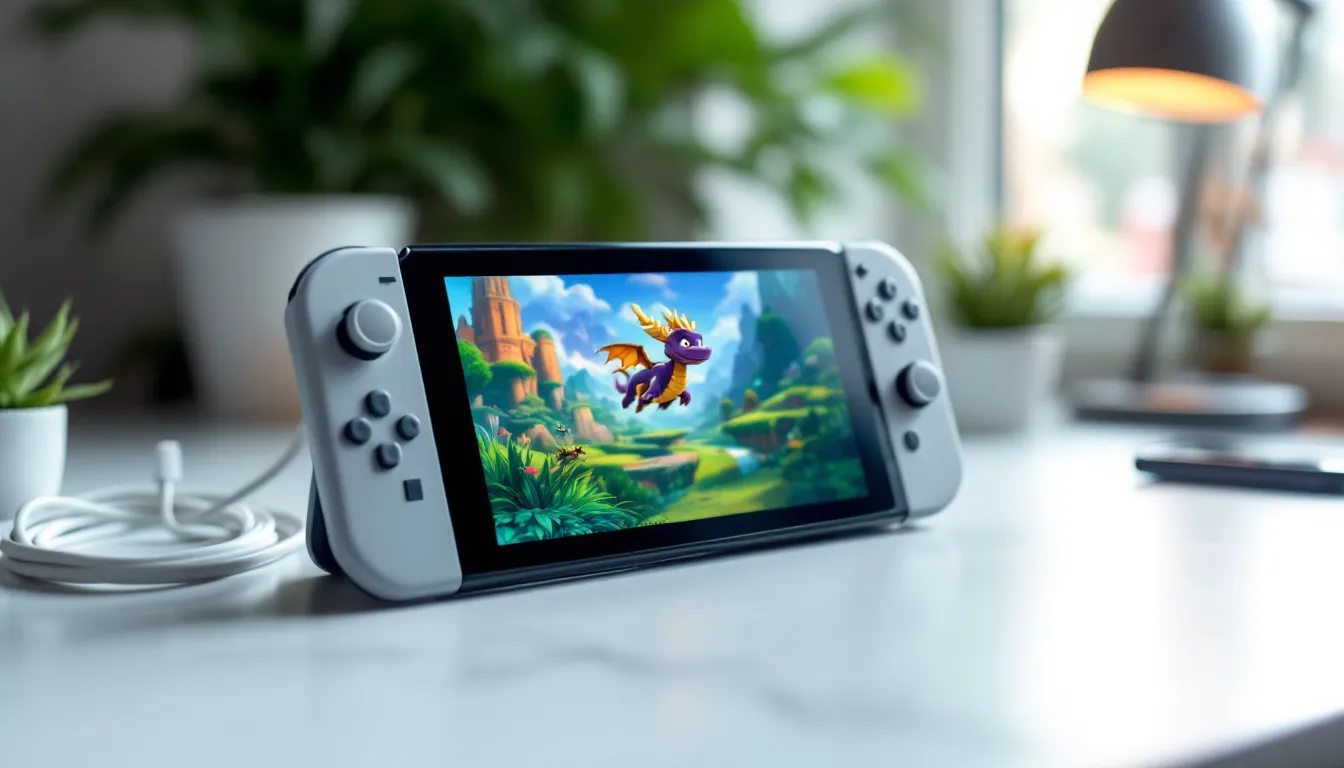
The purple dragon that defined a generation of PlayStation gamers has found a cozy new home on Nintendo Switch. Spyro Reignited Trilogy brings three fully remastered classics to a console that’s all about gaming on your terms, whether you’re gliding through Dragon Shores on your morning commute or flame-grilling Gnasty Gnorc from the comfort of your couch.
If you’re wondering how Spyro holds up on Nintendo’s hybrid console in 2026, you’re in the right place. This guide covers everything from performance quirks and control layouts to speedrunning strats and where to snag the best deals. Whether you’re a returning fan chasing that 120% completion high or a newcomer curious about what all the fuss is about, let’s jump into what makes Spyro on Switch worth your time.
Table of Contents
ToggleKey Takeaways
- Spyro Reignited Trilogy on Nintendo Switch includes all three remastered classics with 50+ hours of content, making it ideal for portable gaming despite its 30 FPS frame rate and lower resolution compared to other platforms.
- The Switch version runs at 900p docked and 576p handheld with mostly stable performance, with handheld mode being the better experience due to the smaller screen masking visual compromises effectively.
- Spyro’s bite-sized level structure and frequent autosaves make the Nintendo Switch port perfect for playing on commutes or in short gaming sessions without sacrificing core gameplay mechanics or collectibles.
- 100% completion requires learning advanced techniques like charge-jump gliding, supercharge ramps, and proxy jumping—speedrunning strategies that add depth for players pursuing full collectible challenges across all three games.
- The physical Switch cartridge only contains Spyro 1 and requires a 3.6 GB download for Spyro 2 and 3, while the eShop digital version costs $39.99 and includes all content, with regular sales dropping the price to $19.99–$24.99.
What Is Spyro Reignited Trilogy?
Spyro Reignited Trilogy is a complete ground-up remake of the first three Spyro games, originally developed by Insomniac Games for the PlayStation back in the late ’90s. Toys for Bob handled the remaster, which launched in November 2018 for PlayStation 4 and Xbox One, with the Switch version dropping in September 2019.
Unlike simple remasters that just upscale textures, Reignited rebuilds every level, character model, and animation from scratch while staying faithful to the original level geometry and gameplay feel. Think of it as putting on a fresh coat of paint that somehow makes you remember the original looking better than it actually did.
The Three Games Included
The trilogy packs in three full campaigns:
-
Spyro the Dragon (1998): The game that started it all. Five dragon homeworlds, 80+ levels when you count the bonus realms, and Gnasty Gnorc turning your dragon buddies into crystal statues. Classic collect-a-thon structure with gems, dragons, and dragon eggs to recover.
-
Spyro 2: Ripto’s Rage. (Gateway to Glimmer in PAL regions, 1999): Widely considered the sweet spot of the trilogy. Introduces new abilities like climbing and swimming, plus NPCs with actual side quests. Ripto’s invasion of Avalar gives the story more personality, and the level design hits peak variety here.
-
Spyro: Year of the Dragon (2000): The biggest of the three, with multiple playable characters beyond Spyro, Sheila the Kangaroo, Sgt. Byrd, Bentley the Yeti, and Agent 9. Over 150 eggs to collect across four homeworlds. The Sorceress wants to harvest baby dragons, and you’re the only one standing in her way.
Each game takes roughly 8-12 hours for a casual playthrough, with 100% completion pushing that to 15-20 hours per title. You’re looking at 50+ hours of purple dragon goodness if you go for full completion across all three.
Key Features and Improvements Over the Originals
Toys for Bob didn’t just slap HD textures on the old models and call it a day. Here’s what changed:
Visual Overhaul: Every asset rebuilt in modern game engines. Characters now have expressive animations, environments feature dynamic lighting and particle effects, and the color palette pops in ways the PS1 hardware could only dream of. The art direction leans slightly more cartoony than the originals, but it works.
Remastered Soundtrack: Stewart Copeland’s iconic score got re-recorded with live instruments. You can toggle between the new orchestrated versions and the original PS1 tracks in the settings, a nice touch for purists.
Quality of Life Tweaks: The camera system received major improvements (the original Spyro 1 camera was notoriously janky). There’s also a dedicated “fly mode” camera option and improved flight controls that make Spyro 2’s speedway challenges less of a controller-throwing experience.
Skill Point System: Achievements-before-achievements that unlock bonus art galleries and cheat codes. These existed in Spyro 2 and 3 originally but got expanded and refined here.
All DLC Included: The Switch version ships with all content from day one, no additional downloads required beyond the initial patch (more on that later).
The remaster doesn’t fundamentally change gameplay mechanics or level layouts, which is exactly what longtime fans wanted. If you could sequence-break the original with a well-timed glide, chances are you still can here.
How Spyro Performs on Nintendo Switch
Performance is where the Switch version makes some compromises to fit on Nintendo’s less powerful hardware. Let’s break down what you’re actually getting.
Graphics and Visual Quality Comparison
The Switch version targets 900p docked and 576p in handheld mode. That’s noticeably lower than the 1080p/1440p you’ll see on base PS4/Xbox One, and miles behind the 4K output on PS4 Pro, Xbox One X, or current-gen consoles running backwards compatibility.
Texture quality takes a hit too. Environmental details like grass density, shadow resolution, and distant LOD (level of detail) are scaled back. Side-by-side comparisons with aggregated game review scores show the visual downgrade is most apparent in busy levels like Colossus or Fracture Hills, where the Switch version can look slightly muddy in handheld mode.
That said, the art direction is strong enough that Spyro still looks great on the Switch screen. The lower resolution is less noticeable when you’re not directly comparing platforms, and the vibrant color palette helps mask some of the technical limitations. Portable Spyro is still charming as hell.
Frame Rate and Performance Analysis
Spyro Reignited on Switch targets 30 FPS in both docked and handheld modes. Other platforms run at 30 FPS on base hardware or 60 FPS on PS4 Pro/Xbox One X with unlocked frame rate modes.
The 30 FPS lock is mostly stable, but there are hitches. Loading new sections of a level can cause brief frame drops, especially in Spyro 3’s more complex stages. Certain particle-heavy effects (like the whirlwinds in Spyro 2’s Zephyr or multiple enemies on screen) will occasionally dip into the mid-20s.
For a 3D platformer, 30 FPS is perfectly playable, Spyro isn’t a twitchy shooter where every frame matters. The input lag is minimal, and the controls feel responsive enough that you won’t miss jumps because of performance issues. Still, if you’re coming from a 60 FPS version on PS5 or Xbox Series X, the difference is noticeable.
Handheld vs. Docked Mode Experience
Handheld mode is where the Switch version truly shines, not because of technical superiority, but because of context. Spyro’s level-based structure is perfect for portable gaming. Knock out a couple of realms on a lunch break, hunt for that one gem you missed during your commute, it just works.
The visual downgrade is less offensive on the Switch’s 6.2-inch screen compared to a 55-inch TV. The lower resolution and reduced texture quality are harder to spot when the screen is smaller, and the game maintains its charm in handheld mode.
Docked mode is where the compromises become more apparent. The 900p upscale to 1080p introduces some softness, and you’ll notice pop-in and lower-quality shadows more readily on a larger display. It’s not bad, Spyro is still completely playable, but if you have access to a PS5, Xbox Series X, or even a mid-range gaming PC, those versions offer a significantly better visual experience on a TV.
Battery life in handheld averages around 3-3.5 hours on a standard Switch model, which is decent for a 3D game. The OLED model’s improved screen makes handheld mode even more appealing, though battery life is only marginally better.
Gameplay Mechanics and Controls on Switch
Spyro’s control scheme translates well to the Switch’s Joy-Cons and Pro Controller, though there are a few quirks worth knowing upfront.
Controller Layout and Button Mapping
The default control layout uses a fairly standard 3D platformer setup:
- Left Stick: Movement
- Right Stick: Camera control
- B Button: Jump (double-tap for glide)
- Y Button: Flame breath
- A Button: Charge attack
- X Button: Action button (talk to NPCs, interact with objects)
- L/ZL and R/ZR: Camera snap left/right, or in some cases, lock-on targeting in Spyro 2 and 3
- Minus Button: Pause menu
- Plus Button: Map/inventory
The jump-to-glide timing is crucial and feels slightly different than the original PS1 version due to input buffering differences. You want to tap B again at the apex of your jump for maximum glide distance. It takes a few minutes to adjust if you’re coming from another platform, but muscle memory kicks in fast.
One common complaint: the default camera sensitivity feels sluggish. Head into the settings menu and bump the camera speed up a notch or two for a more responsive experience. The original Spyro games had some wonky auto-camera behavior, and while Reignited improves it, manual camera control is still your best friend in tight spaces.
Motion Controls and Pro Controller Support
The Switch version includes optional gyro aiming for certain mini-games like the speedways and Sgt. Byrd’s flying missions in Spyro 3. It’s not a game-changer, but if you’re a fan of motion controls from Splatoon or Breath of the Wild, it can make aiming fireballs or egg shots slightly more precise. You can toggle it on or off in the options.
Pro Controller support is fully implemented and honestly the recommended way to play docked. The Pro Controller’s larger grips and better ergonomics make extended play sessions more comfortable, and the analog sticks offer finer control for gliding precision. Joy-Cons work fine, especially in handheld mode, but the smaller sticks can make camera control fiddlier during intense platforming sections.
There’s no touch screen functionality for menus, which is a missed opportunity but not a dealbreaker. Games tailored for family-friendly experiences sometimes integrate touch controls, but Spyro sticks to traditional inputs.
Getting Started: Essential Tips for New Players
Jumping into Spyro for the first time, or returning after a couple decades? Here’s what you need to know to make the most of your playthrough.
Understanding Collectibles and Completion Goals
Spyro is a collect-a-thon at heart, and each game has its own set of completion requirements:
Spyro 1:
- Gems: Currency and the main collectible. Each level has a specific gem count (displayed on the pause screen). You need gems to unlock later homeworlds.
- Dragons: 80 total across all levels. Rescuing them grants you permanent progress checkpoints.
- Dragon Eggs: 12 eggs hidden in bonus levels unlocked by completing certain tasks.
- Completion Goal: 120% requires all gems, all dragons, and all eggs.
Spyro 2: Ripto’s Rage:
- Gems: Still important, but less about unlocking worlds and more about progression within levels.
- Talismans: One per level, earned by completing the main objective.
- Orbs: 64 total. These are the real progression currency. You need a certain number to unlock boss fights and new homeworlds. Orbs are earned through side quests, mini-games, and challenges.
- Skill Points: 16 hidden challenges that unlock bonus content.
- Completion Goal: 100% requires all orbs, all talismans, and all skill points.
Spyro 3: Year of the Dragon:
- Gems: Same deal as Spyro 2.
- Dragon Eggs: 150 total. These replace talismans and orbs as the primary collectible. You earn eggs by completing levels, side quests, mini-games, and challenges.
- Skill Points: 20 hidden challenges.
- Completion Goal: 117% requires all eggs and all skill points.
The percentage counters are a quirky holdover from the originals. Don’t stress about the math, just focus on clearing your checklist.
Best Practices for 100% Completion
Going for full completion? Here’s how to minimize backtracking and frustration:
Clear levels thoroughly on your first visit. It’s tempting to rush through, but taking your time to explore every nook saves headaches later. Use the pause menu to check your gem/collectible count before moving on.
Master the glide early. Most hidden gems and collectibles require precise gliding. Practice chaining double-jumps into glides and adjusting mid-flight with the analog stick. The tighter your movement, the fewer attempts you’ll need for tricky platforming sections.
Talk to every NPC. In Spyro 2 and 3, side quests aren’t always obvious. NPCs standing around often have orbs or eggs locked behind tasks. Exhaust dialogue options to make sure you’re not missing content.
Don’t sleep on Skill Points. These hidden challenges range from “flame all trees in a level” to “complete a speedway in under X seconds.” Some are easy, others require speedrunning techniques and frame-perfect execution. Check a guide if you’re stuck, Skill Points can be cryptic.
Save speedways for later. The timed flying challenges in all three games are notoriously difficult. Come back to these once you’ve got the flight controls down and you’re comfortable with Spyro’s movement. Hunter’s speedway challenges in Spyro 2 are particularly brutal.
Use Sparx wisely. Your dragonfly buddy Sparx serves as your health meter (gold = full health, blue = two hits left, green = one hit left, gone = one hit from death). Sparx also picks up nearby gems automatically when he’s gold. If you’re low on health, flame small enemies or break vases to recover.
Check the Guidebook. The in-game Atlas (accessed via the pause menu) tracks your collectibles per level and highlights what you’re missing. Use it liberally to avoid aimless wandering.
Advanced Strategies and Speedrunning Techniques
Once you’ve cleared the games casually, the real fun begins. Spyro’s movement system has depth that speedrunners have been exploiting for years.
Gliding and Movement Optimization
Efficient movement is the backbone of fast Spyro play. Here are the key techniques:
Charge-Jump Gliding: Charging (holding A) before jumping grants extra momentum. Release the charge, jump at the last second, then glide. This extends your glide distance significantly and is essential for reaching out-of-the-way platforms without taking the intended route.
Supercharge Ramps: Certain levels feature supercharge ramps that launch Spyro at high speed. These can be chained with jumps and glides to skip large sections of levels. Speedrunners use supercharge tech extensively in levels like Wild Flight (Spyro 1) and Hurricos (Spyro 2).
Proxy Jumping: A glitch from the originals that still works in Reignited. If you jump while touching a wall or object at the right angle, Spyro gains extra height. This allows for out-of-bounds skips and sequence breaks. Tricky to execute but game-changing for speedruns.
Flight Mini-Game Routes: Speedways have optimal gem/object collection routes. The fastest paths often involve collecting items in a specific order to minimize flight time and sharp turns. Watching meta analysis from skilled runners can shave minutes off your times.
Camera Manipulation: Adjusting the camera mid-glide can help you spot landing zones or hidden platforms. Speedrunners often use the R/L snap function rapidly to scout surroundings without losing momentum.
Gem Route Planning Across All Three Games
For 100% speedruns or efficient casual playthroughs, gem routing matters. Here’s the high-level strategy:
Spyro 1: Gem counts are fixed per level, and gems respawn if you die, so the routing is straightforward. The main optimization is minimizing backtracking. Clear levels in a circular pattern, start at the entrance, sweep one side, loop back via the other. Use the Guidebook to confirm you’ve hit the gem count before exiting.
Spyro 2 and 3: Gems are less critical for progression but still required for 100%. The wrinkle: some gems are locked behind completing specific tasks or orb challenges. Plan to revisit levels after unlocking new abilities (like climbing or headbash) to access previously unreachable areas.
Backtracking Efficiency: In all three games, certain collectibles require abilities you don’t have yet. Note these on your first pass and batch them together when you return. For example, in Spyro 2, you can’t climb or swim until after beating the first boss. Mark levels with climbing/swimming sections and clear them in one sweep after unlocking those skills.
Speedway Optimization: Speedways are the most routing-intensive challenges. Each one has a “perfect” path that completes all objectives within the time limit. These routes require memorization and tight execution. Practicing individual speedways in Time Attack mode is the best way to internalize the routes without the pressure of a full game run.
How Spyro Switch Compares to Other Platforms
If you own multiple platforms, or you’re deciding where to buy Spyro Reignited, here’s how the Switch version stacks up.
Switch vs. PlayStation and Xbox Versions
The performance and visual gap is clear:
Resolution: PS4/Xbox One run at 1080p or higher: Switch tops out at 900p docked, 576p handheld.
Frame Rate: PS4 Pro/Xbox One X offer unlocked 60 FPS modes. PS5 and Xbox Series X/S run the game at a locked 60 FPS via backward compatibility. Switch is locked at 30 FPS with occasional drops.
Load Times: PS5 and Series X load levels in 5-10 seconds thanks to SSD speeds. Switch load times hover around 15-25 seconds depending on whether you’re running from cart or digital. It’s not excruciating, but it adds up during frequent deaths or level hopping.
Visual Fidelity: Texture quality, shadow resolution, and draw distance are all noticeably better on PlayStation and Xbox. If you’re playing on a big TV, the difference is obvious.
That said, the Switch version is functionally identical in terms of content and gameplay. Every level, collectible, and feature is present. The trade-off is purely technical performance versus portability.
Is the Portability Worth Any Trade-Offs?
For many players, yes, absolutely. Spyro’s structure makes it ideal for handheld play. Levels are bite-sized (5-15 minutes each), and the game saves frequently. You can knock out a homeworld during a commute or grind for that last skill point while binge-watching TV.
If you primarily play docked on a large TV and own a PS5, Xbox Series X, or gaming PC, those platforms offer a better visual and performance experience. But if you value the flexibility of portable gaming, or if Switch is your primary console, Spyro Reignited is a solid pickup. The portability factor alone makes the Switch version compelling for players who enjoy platform flexibility.
One more consideration: the Switch community. While Spyro isn’t an online multiplayer title, the Switch player base tends to skew toward casual and family-friendly gaming. If you’re introducing the series to younger players or want something you can pass around on a single console, Switch is a natural fit.
Where to Buy and Current Pricing in 2026
As of March 2026, Spyro Reignited Trilogy remains widely available both digitally and physically for Nintendo Switch.
Digital vs. Physical Editions
Digital (eShop): The game currently sits at $39.99 USD on the Nintendo eShop. Digital is convenient, but keep in mind the file size is roughly 13.5 GB including the mandatory day-one patch that adds Spyro 2 and 3 content. (Yes, even the physical cart requires a download, more on that shortly.) Digital purchases are tied to your Nintendo Account and can be redownloaded anytime.
Physical (Cartridge): Physical copies typically run $29.99-$39.99 new depending on the retailer, with used copies available for $20-$25. The catch: the physical cart only contains Spyro 1. Spyro 2 and 3 require a 3.6 GB download from the eShop to play. This was a cost-cutting move by Activision, and it’s annoying for collectors who prefer truly complete physical releases.
If you’re tight on storage or prefer resellability, physical is the way to go. If you want the convenience of all-digital and don’t mind the storage footprint, eShop works fine.
Sales and Deals to Watch For
Spyro Reignited goes on sale fairly regularly. Here’s when to expect discounts:
eShop Sales: Nintendo runs seasonal sales (Spring, Summer, Black Friday, Cyber Monday) where third-party titles like Spyro often drop to $19.99-$24.99. Check Nintendo Switch news sites for sale alerts, or use price-tracking tools like Deku Deals to get notified when Spyro drops in price.
Physical Retailer Sales: Big-box retailers (Target, Walmart, Best Buy) occasionally run buy-two-get-one-free promotions on games, which can stack with Spyro physical copies. You can also find discounted copies at GameStop or via Amazon third-party sellers.
Used Market: If you’re not picky about owning new, eBay and local game shops often have used copies for $15-$20. Just double-check the cart is in good condition and includes the insert with the download code (if applicable).
Regional Pricing: If you’re savvy about eShop regions, some countries offer lower prices. The South African or Russian eShop, for example, occasionally prices Spyro significantly cheaper than the US store. You can create a secondary Nintendo Account set to that region and purchase games there, though you’ll need to buy eShop credit from third-party sellers since most credit cards are region-locked.
Common Issues and Troubleshooting
The Switch version of Spyro Reignited is stable overall, but there are a few known quirks and fixes.
Fixing Performance Hiccups and Loading Times
Frame Rate Drops: If you’re experiencing worse-than-usual frame drops, try these steps:
- Close background software. The Switch runs apps in the background even when suspended. Hold the home button on a game icon and close any software you’re not actively using.
- Restart your console. Sounds basic, but a full reboot (hold power button, select “Power Options,” then “Restart”) clears memory leaks that can cause slowdown after extended play sessions.
- Play from cartridge vs. digital (or vice versa). Some users report slightly better performance running from the physical cart, though this is anecdotal. The difference, if any, is marginal.
Longer Load Times: If load times feel excessive:
- Ensure you’re on the latest patch. Check for software updates in the home menu (press + on the Spyro icon, select “Software Update”). Activision released a few post-launch patches that improved load times.
- Clear cache/reinstall. If you’re digital, archive the software and redownload. For physical, delete the update data and redownload the patch. Corrupted data can cause slowdown.
- Upgrade your SD card. If you’re running games off a slow microSD card, load times will suffer. A UHS-I rated card (90+ MB/s read speed) is recommended for optimal performance.
Crashes or Freezing: Rare, but it happens. If the game locks up:
- Hold the power button for 12 seconds to force a shutdown. Restart and try again.
- Check for overheating. If your Switch feels hot to the touch, let it cool down. Overheating can cause crashes, especially in docked mode during extended sessions.
- Test with another game. If crashes persist across multiple titles, your Switch may need repair.
Save File Management and Cloud Backup
Spyro Reignited fully supports cloud saves via Nintendo Switch Online. Your progress auto-uploads to the cloud as long as you’re subscribed to NSO. This is clutch for players who own multiple Switch consoles (standard and OLED, for example) and want to sync progress.
To manually back up or restore saves:
- Go to System Settings > Data Management > Save Data Cloud.
- Select Spyro Reignited Trilogy.
- Choose “Download Save Data” to pull from the cloud, or let it auto-upload after each session.
If you’re not subscribed to NSO, your saves live exclusively on the console’s internal storage. Transfer saves to a new Switch by going to System Settings > Users > Transfer Your User Data. This moves all save data tied to your account, including Spyro.
One heads-up: save data cannot be copied to microSD cards on Switch. It’s internal storage or cloud only. So if your console dies and you’re not using NSO cloud saves, your progress is gone. Subscribe to NSO if you care about your 117% completion file.
For players invested in competitive fighting games or experiences across different platforms, cloud saves are a lifesaver. Spyro might not be competitive, but losing 50 hours of collectible hunting sucks just as much.
Conclusion
Spyro Reignited Trilogy on Nintendo Switch isn’t the prettiest or smoothest version, but it nails what matters most: bringing three timeless platformers to a console where you can play them anywhere. The 30 FPS cap and visual downgrades are real, but they don’t break the experience. Spyro’s charm, tight level design, and addictive collect-a-thon gameplay shine through regardless of resolution.
If you’re debating between platforms, ask yourself this: do you value portability and convenience over raw performance? If the answer is yes, the Switch version delivers. If you’re chasing the best visuals and smoothest frame rate, look to PlayStation, Xbox, or PC. But for most players, especially those who want Spyro on the go, the Switch version is the definitive way to experience these classics in 2026.
Whether you’re chasing that 120% in the original, hunting orbs in Ripto’s Rage, or collecting eggs in Year of the Dragon, Spyro on Switch gives you the freedom to flame, glide, and charge your way through the Dragon Realms on your own terms. And really, that’s what the purple dragon has always been about.